|
home ||| superimposed city tours ||| archive |||
|
Psychogeographical mapping of coincidence in Leeds and Dortmund. Drifting through superimposed narratives of two cities at once.
|

|
||| Drifting round Dortmund: A brief report on my visit, 10-13 Nov 2002-11-23 |||
Time constraints mean that this report is brief, but I hope it gives a decent indication of my activities, and a basic flavour of the city. The report is episodic, and strays across thoughts and impressions rather than describing my linear time there.
My visit to Dortmund was very rushed, and it only gave me two full days to get a feeling for the place while taking audio and photographic footage for the project. I spent most of my time walking around the city centre, and visited the Steinwache Memorial Museum and the University of Dortmund.
I knew from my research that very little of old Dortmund survived the allied bombing raids during the latter half of the Second world War. Over 90% of the city centre was completely destroyed. Seeing the physical evidence was very humbling. History is inscribed in the street layout of the centre, which still relates to old routes and city walls - though overlaid with the brave new city planning of the 50s, which sought to remake Dortmund for the automobile. Above ground level, evidence of pre-war habitation is difficult to find: occasional buildings; street furniture including old photographs; plaques; and the three magnificent churches. The effect is disorientating, particularly on streets like Westenhellweg whose valuable old plots have been repopulated with often brash new buildings, overlooking the narrow thoroughfare.
Many of the streets were widened during the redevelopment, although some streets remade for cars have been remodelled again for pedestrians. The central shopping area is extensively pedestrianised, and remarkably quiet. The contrast with the noise of traffic that seems to permeate Leeds city centre is remarkable. I formulated an impression of the two places moving at different speeds, Leeds populace frantically tearing around while Dortmund appeared leisurely by comparison.
There are reminders of old Dortmund all over the place. The old Rathaus, which had stood on the Alter Markt, is commemorated in the names of surrounding buildings. Post-war replacements for old buildings often proclaim their earlier origins. A profound sense of loss permeates some locations, while others like Hansaplatz - which was having an enormous Christmas tree structure built in it - have an air of magnificence about them. The major new plaza, between the Stadthaus and new Rathaus, seems a little removed from areas of activity, and plays host to a tall column proclaiming 'Peace'.
North Dortmund is split from the centre by the Hauptbahnhof railway station. The old station was destroyed, and the new structure looks quite plain, fronted by what look like cheap cafes and shops. The north side can be reached via a wide underground pedestrian concourse. I emerged to find the Steinwache almost next door to the Alcatraz Canteen. A couple of hundred metres along the road, rows of residential flats are adorned by graffiti. This area corresponds with Leeds Quarry Hill in my superimposition. The traffic is very busy here, much of it coming from the direction of the disused Union Brewery building which is as much of a landmark as the churches in the centre.
The north side was described to me as the 'seamy' area. Platz Von Leeds, which overlooks the main tram lines on Kampstrasse, used to be similarly tarnished with an unhealthy reputation. It now forms the gateway from Reinoldikirche tram and underground station to the new Konzerthaus. Only the Leed's Pub (correct spelling) hints at the area's unsavoury past, although the narrow streets beyond the Konzerthaus are populated by a mixture of bohemian and adult establishments: head shops; hippy clothes shops; slot machine parlours; an adult cinema and a strip joint.
The architecture of central Dortmund indicates the city's post-war intention to put the past behind it and strive towards a positive future. That future is yet to come. The heavy industries that once dominated the economy have been through recession and disappeared or diminished. The city is attempting to restructure itself towards new media and service industries, and the process is proving painful. Dortmund's populace still awaits its resurgence, though the homeless are much less visible than in Leeds, which is probably the most prosperous city in the north of England.
My overall impressions of Dortmund are very mixed. Its heritage is proudly inscribed in every surviving pre-war façade, and displayed in its museums and on its pub walls. A new book, Das Neue Dortmund: Planen, Bauen, Wohnen in den Fünfziger Jahren, indicates utopian aspirations of post-war reconstruction. Those aspirations have successfully been translated to the physical environment, though the 50's office block style replicated throughout the city occasionally produces loci of alienation and sterility. Dortmund feels like a utopian vessel waiting for its society to catch up and fill it with vigour. A doctor offered me the most apt description of its environment, during a brief discussion on a tram. "Dortmund", she said, "is a place with a special nothing."
Acknowlegements
Very big thank you to Rob Lycett for lend of equipment, and to Professor Gerhard Sollbach at the University of Dortmund for his support of the project.
|
||| offsite: articles |||
|
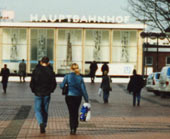
||| Approaching Hauptbahnhof |||
|
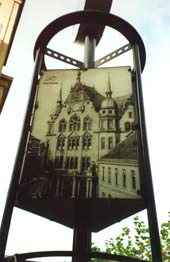
||| Old Rathaus on street sign |||
|
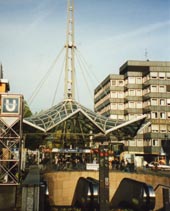
||| U-Bahn at Reinoldikirche |||
|
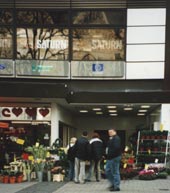
||| Westenhellweg |||
|
|